
Vijaybhoomi University Student Team Shortlisted for ISRO’s IRoC-U 2025 Drone Challenge
2026-11-23 10:02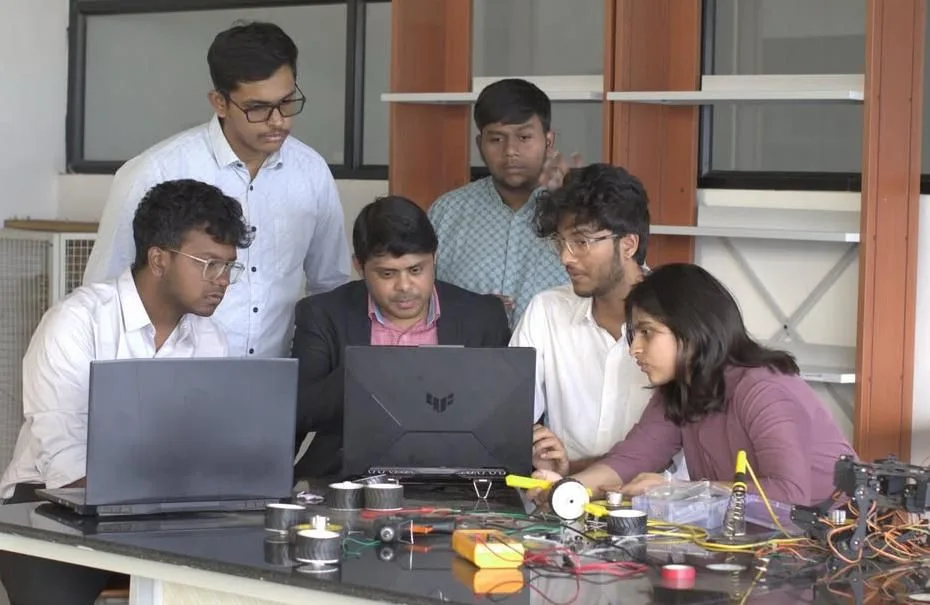
Vijaybhoomi University Student Team Shortlisted for ISRO’s IRoC-U 2025 Drone Challenge
Vijaybhoomi University Student Team Shortlisted for ISRO’s IRoC-U 2025 Drone Challenge
The team’s design proposal explored how an autonomous drone could navigate a Mars mission scenario without GPS. It was one of 177 shortlisted from more than 2,000 entries across India.
Mars has no GPS infrastructure to guide a drone. For a team of students from Vijaybhoomi University’s School of Science and Technology (VSST), that constraint became the starting point for the ISRO IRoC-U 2025 Drone Challenge.
The challenge called for an autonomous aerial vehicle that could take off, hover, survey terrain, identify a safe landing site and return to its starting point, all without a person flying it.
Designing for a place without GPS
In their proposal, the students described using a Raspberry Pi as the drone’s onboard computer and combining multiple navigation methods. Each method could help map the surroundings; comparing their results would help the team identify which information they could rely on.
Safety was central to the proposed design. A landing site would be accepted only if the navigation systems agreed and the ground appeared suitable. If they did not agree, the system would reject the site. As team member Bhargavaram Krishnapur explained, an autonomous system on another planet cannot rely on an operator to correct a poor decision.
A shortlist, and work that continued
The team’s design proposal was shortlisted among 177 teams from more than 2,000 across India. It progressed to the next stage but did not make the on-site finals at URSC Bengaluru.
The result did not bring the project to a stop. The students continued working on the drone, motivated by what they had learned and by the wish to see their work progress beyond the proposal stage. None of them had built a drone before. They were learning how to build one while also understanding how Mars’s conditions, especially its thin atmosphere and lack of GPS, would change the design problem.
Guidance, space and support to build
Dr. Salur Srikant Patnaik, Assistant Dean at VSST, held weekly project reviews with the team and was involved in the design process. Vijaybhoomi University supported the work with lab space, a meeting room and funding for components and in-house fabrication.
Being able to make parts on campus helped the students work iteratively: when something did not fit, they could revise the design and make another part without waiting for a new order.
For the team, the experience showed that a shortlist is only one step. Taking a proposal further requires time, continued funding, access to testing space and guidance from people with flight-systems experience. It also gave the students something lasting: the chance to learn through a challenging project, keep working after the competition and pass that experience on to the next team.
Read their story in The New Indian Express:
Bengaluru professor-led team’s drone gets fine-tuned for Mars